

Cart
0
How to Use Creatine to Tone Muscle and Improve Blood Sugar

Written By: Diana Licalzi, Registered Dietitian & Jose Tejero, Exercise Physiologist
The Ultimate Guide to Improve Blood Sugar Levels with Creatine
Creatine is one of the most researched supplements in existence. Study after study supports its benefits for strength, power, recovery, and even cognitive performance. It is inexpensive, simple, and has been around for decades.
Yet for millions of people, especially those over 45, creatine remains misunderstood, undertaken incorrectly, or skipped altogether.
They are told:
-
Creatine is safe.
-
Creatine helps with muscle and blood sugar levels.
-
Creatine has been researched extensively.
All of that is true. And still it feels incomplete.
Why?
Because the most important story about creatine is rarely told: muscle is your body's primary glucose disposal organ. The more lean, active muscle tissue you carry, the more efficiently your body clears sugar from your bloodstream.
Creatine is one of the most powerful tools available to build, preserve, and energize that muscle — and in doing so, it becomes one of the most underappreciated tools for metabolic health and blood sugar control.
This guide explains how creatine works, why it matters more after age 45 for both men and women, and how JADE Supplements Pure Creatine is formulated specifically to support that mission.
How Creatine Actually Works in Your Body
Creatine supports the body's ability to produce and recycle Adenosine Triphosphate (ATP) — the molecule your cells use for energy. It is not a stimulant or a steroid. It is not a hormone. It is a naturally occurring compound found in your muscle and brain tissue, and it is obtained through both internal production and dietary sources like red meat and fish.
Every muscle contraction, nerve signal, and metabolically demanding process relies on ATP. Creatine acts as a buffer and reserve, helping regenerate ATP during periods of higher demand such as:
-
High-intensity exercise like lifting or interval training
-
Caloric restriction or dieting
-
Periods of high stress
-
Hormonal shifts — especially around perimenopause and menopause for women, and declining testosterone in aging men
-
Cognitive demands: sustained focus, sleep disruption, high-pressure workdays
Key Insight: When your muscles run low on available ATP, they cannot contract as forcefully, recover as quickly, or — critically — pull glucose out of your bloodstream as efficiently. Creatine keeps that energy system running at full capacity.
Research has also shown creatine to support brain and cognitive health, improving memory, focus, and mental processing — especially during aging, stress, and sleep disruption.
The Metabolic Connection: Muscle as a Glucose Vacuum
Here is the part most creatine guides skip entirely, and the reason JADE Supplements created Pure Creatine around metabolic health.
Skeletal muscle is the largest insulin-sensitive tissue in the human body. After you eat, your muscles are responsible for clearing the majority of glucose from your bloodstream.
When muscles are healthy, dense, and metabolically active, they are exceptional glucose vacuums — pulling sugar out of the blood rapidly and efficiently.
When muscle mass declines, blood sugar management deteriorates with it. Insulin resistance deepens. The risk of prediabetes and type 2 diabetes rises. And this muscle loss accelerates dramatically after the age of 45 for both men and women.
GLUT-4: The Door That Lets Glucose Into Your Muscle Cells
Inside your muscle cells are specialized glucose transporters called GLUT-4 receptors. Think of them as doors. When insulin knocks, these doors open and allow glucose to move from your bloodstream into the cell, where it is stored or burned for energy.
Creatine has been shown to increase GLUT-4 activity in muscle cells. More active GLUT-4 expression means more glucose is cleared from the bloodstream, even at rest. This is a direct, measurable mechanism by which creatine supports insulin sensitivity and blood sugar control.
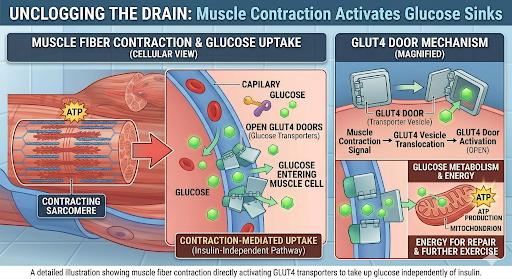
Clinical Evidence: In a 12-week study, adults with type 2 diabetes who took creatine alongside exercise showed significant improvements in glucose control, reductions in HbA1c, and increased muscle GLUT-4 activity. (Gualano et al., Medicine & Science in Sports & Exercise, 2011)
Creatine energizes the muscle. The energized muscle works harder and recovers faster. Harder-working muscle becomes denser and more insulin-sensitive over time. More insulin-sensitive muscle clears glucose from the bloodstream at exponentially higher rates. This is the metabolic cycle that JADE Pure Creatine is designed to support.
Why Creatine Becomes Even More Important After Age 45
After 45, the body begins losing muscle mass at a rate of approximately 1–2% per year — a process called sarcopenia. This is not simply a cosmetic concern. As muscle mass declines, so does the body's capacity to store and clear glucose, regulate insulin, maintain bone density, and sustain functional independence.
At the same time, hormonal changes accelerate this process. Declining estrogen in women and declining testosterone in men both reduce the efficiency of protein synthesis and muscle preservation. Recovery slows. Strength plateaus. Metabolic flexibility decreases.
Creatine directly addresses these changes.
For Women After 45: Perimenopause and Menopause
As estrogen declines, the body's natural creatine synthesis and muscle energy systems come under increasing strain. Research suggests that estrogen plays a direct role in how efficiently cells manage energy — meaning declining estrogen can reduce the body's natural creatine availability at exactly the moment when maintaining muscle is most critical.

Creatine supplementation during perimenopause and menopause helps:
-
Preserve lean muscle mass that is critical for blood sugar management
-
Support training tolerance and recovery as hormonal variability increases
-
Smooth out energy dips and cognitive fatigue associated with estrogen fluctuation
-
Maintain metabolic resilience and bone-protective muscle strength
For Men After 45: Maintaining Metabolic Muscle
Men experience their own version of this challenge. As testosterone declines with age, the anabolic signals that preserve muscle become weaker. Muscle loss and fat accumulation around the abdomen increase insulin resistance and metabolic risk.

Creatine supports men after 45 by:
-
Fueling harder training sessions that create the stimulus for muscle preservation
-
Supporting faster recovery so training can be sustained consistently
-
Maintaining strength and power output as hormonal support decreases
-
Enhancing GLUT-4 activity to improve glucose clearance and insulin sensitivity
For both men and women, the goal after 45 is not to look like an athlete. It is to maintain the metabolically active muscle tissue that protects long-term health, independence, and blood sugar control.
Creatine, Hormones, and Blood Sugar: What the Science Shows
There is no credible evidence that creatine disrupts estrogen, progesterone, testosterone, or normal hormonal signaling. It does not raise androgens to clinically meaningful levels or cause masculinization. It does not interfere with thyroid function or cortisol regulation.
What creatine does affect — positively — is cellular energy availability. And cellular energy is the foundation on which hormonal balance, glucose metabolism, cognitive function, and physical resilience are built.
Blood Sugar and Insulin Sensitivity
The pathway from creatine to better blood sugar is direct and well-documented:
-
Creatine increases phosphocreatine stores in muscle, giving cells more immediately usable energy
-
Muscles with higher energy availability contract more forcefully and recover faster
-
More active, better-recovered muscle increases GLUT-4 transporter expression
-
Higher GLUT-4 activity allows muscles to pull more glucose from the bloodstream
-
Over time, consistent training supported by creatine increases lean muscle density — permanently improving the body's glucose disposal capacity
This is why JADE Supplements positions Pure Creatine not just as a performance supplement, but as a foundational tool for metabolic health — especially for anyone managing prediabetes, insulin resistance, or blood sugar concerns.
Cognitive Energy and Brain Health
The brain is one of the body's most energy-hungry organs. Creatine is stored in neural tissue and helps maintain ATP availability during periods of high cognitive demand. For both men and women, this can manifest as greater mental stamina, improved focus, and reduced cognitive fatigue — especially during long workdays, sleep disruption, or elevated stress.
After 45, cognitive energy management becomes increasingly important. Creatine's support of brain energy metabolism is a meaningful — if often underappreciated — benefit of consistent supplementation.
Addressing Common Concerns
Will Creatine Make Me Gain Weight or Look Bloated?
The scale may go up within the first one to two weeks of starting creatine. This is not fat gain. It reflects water moving into muscle cells — which is exactly what should happen.
Creatine draws water into muscle tissue, and better-hydrated muscle produces more force and clears glucose more efficiently. This is a sign that creatine is working. The weight increase is intracellular — it makes your muscles look slightly fuller, not puffy or soft.
Common contributors to actual bloating or digestive discomfort include:
-
Taking too large a dose too quickly
-
Following aggressive loading protocols
-
Mixing creatine in too little water
-
Inadequate daily hydration
JADE Pure Creatine is micronized for better solubility and gentler digestion. Starting at the clinical dose of 5g daily — with adequate water — minimizes discomfort for the vast majority of users.
Does Creatine Cause Hair Loss?
There is no solid evidence that creatine causes hair loss in men or women. One 2009 study showed a transient increase in DHT (a hormone associated with hair thinning in genetically susceptible individuals), but that finding has not been replicated in subsequent research. The current scientific consensus does not support a causal link between creatine supplementation and hair loss.
Is Creatine Safe for People Managing Blood Sugar?
Creatine is generally well-tolerated and considered safe for healthy individuals. The research specifically in populations managing type 2 diabetes is promising, with studies showing improved glycemic control and insulin sensitivity when creatine is combined with exercise. However, anyone with kidney disease or a significant medical condition should consult a qualified healthcare provider before supplementing. JADE Supplements always recommends personalizing supplementation with medical guidance.
Does Creatine Break a Fast?
Creatine contains no calories and does not meaningfully affect blood glucose or insulin levels in isolation. From a metabolic standpoint, it does not break a fast. If you fast for digestive rest or personal preference, you may prefer taking it with your first meal of the day.
Creatine Across Life Stages
Ages 30–45: Building the Foundation
In your 30s and early 40s, muscle-building efficiency begins to slow. Training harder helps, but recovery takes longer. Creatine supports greater training output and faster recovery, building the metabolic muscle density that will pay dividends for decades.
The most common mistake at this stage is underdosing or using creatine sporadically, which limits saturation and blunts its benefits.
Ages 45–60: The Critical Window
This is the most important window for creatine supplementation. Muscle loss accelerates, hormonal support declines, and insulin resistance risk rises. The gap between people who maintain metabolic muscle and those who do not begins to widen dramatically.
Creatine at this stage is less about pushing harder and more about preserving what you have — keeping muscles energized, dense, and metabolically active so they continue functioning as effective glucose disposal systems.
Ages 60 and Beyond: Functional Independence
Maintaining muscle mass becomes directly linked to functional independence, fall prevention, bone density, and cognitive resilience. Creatine, combined with resistance training, has been studied in older adults for its ability to support lean mass, strength, and physical capacity.
The metabolic benefits compound as well — healthy muscle in older age means better blood sugar regulation, lower cardiovascular risk, and greater overall resilience.
Pregnancy and Breastfeeding
Pregnancy is a period of extraordinarily high energy demand. Emerging research suggests creatine may play a protective role in fetal development, particularly in contexts involving oxygen stress or complicated deliveries. Some researchers have proposed that maternal creatine status may influence fetal neurological outcomes.
However, large-scale randomized controlled trials in pregnant women are still limited, and formal obstetric guidelines have not universally adopted creatine supplementation as standard practice. If you are pregnant or breastfeeding, discuss supplementation with a qualified healthcare professional before proceeding.
JADE Supplements Pure Creatine
How Much to Take
5 grams daily of creatine monohydrate is the clinically studied dose — sufficient to saturate muscle stores and support the metabolic and performance benefits documented in research. JADE Pure Creatine provides exactly 5g per serving, with no fillers, additives, or proprietary blends.
More is not necessarily better. Consistency is what matters. Daily use maintains elevated muscle creatine stores that support steady glucose disposal capacity.
Do You Need a Loading Phase?
No. Loading protocols — typically 20 grams daily for 5–7 days — saturate muscle stores faster, shortening the saturation timeline from 3–4 weeks to approximately one week. However, loading dramatically increases the likelihood of digestive discomfort and bloating, and provides no long-term advantage.
A steady 5g daily dose achieves full muscle saturation within 3–4 weeks with minimal side effects. JADE does not recommend loading.
Hydration: More Important Than Most People Realize
Creatine monohydrate has modest solubility in cool water. Five grams will not fully dissolve in a small glass of cold water. Undissolved creatine crystals can sit in the gut and contribute to bloating or loose stools as they slowly dissolve.
To get the best results and minimize discomfort:
-
Use at least 12–16 oz (350–500 ml) of fluid per 5g dose
-
Mix with room temperature or slightly warm water for better solubility
-
Stir until the liquid is fully clear before drinking
-
Aim for 2–3 liters of total daily fluid, adjusting for activity, heat, and sweat
Creatine increases intracellular water demand. Staying well hydrated is essential — not just for creatine's effectiveness, but for blood sugar regulation and overall metabolic function.
When to Take It
There is no single optimal time of day. Creatine works by maintaining elevated stores over time, not by spiking at any particular moment. You can take it:
-
In the morning with breakfast
-
Post-workout in a protein shake or smoothie
-
Mixed into coffee (creatine is stable in warm beverages — add after pouring, stir well)
-
At any convenient time on rest days
Taking creatine with a meal containing carbohydrates may modestly enhance muscle uptake due to insulin's role in nutrient transport — which aligns well with JADE's focus on supporting healthy insulin response.
Should You Take It Every Day — Including Rest Days?
Yes. Muscle creatine stores are maintained by consistent daily intake. Stopping and starting based on the workout schedule reduces saturation and limits effectiveness. Treat it like any other foundational supplement — daily, regardless of whether you train.
What Happens If You Stop?
If you stop supplementing, muscle creatine levels gradually return to baseline over several weeks. Any increase in intracellular water will normalize, which may show up as a small drop on the scale. You will not experience hormonal disruption or withdrawal. You will simply lose the elevated creatine reserve that supplementation provided — and the metabolic muscle advantages that come with it.
The Simple Summary
Daily Protocol: 5 grams of JADE Pure Creatine monohydrate, dissolved in 12–16 oz of water or mixed into a shake or coffee, every day.
-
5g daily — the clinically studied dose
-
No loading phase required
-
Take every day, including rest days
-
Timing is flexible — find what fits your routine
-
Mix with coffee, protein shake, smoothie, or water
-
Stay well hydrated — 2–3 liters of total fluid daily
-
Pair with resistance training for maximum metabolic benefit
Creatine works best when it becomes automatic. The benefit is not dramatic day-to-day — it accumulates over weeks and months as your muscles stay saturated, your training improves, and your metabolic muscle density increases. That compound effect on blood sugar control is the point.

About JADE Supplements Pure Creatine
JADE Supplements was founded by Diana Licalzi, Registered Dietitian, and Jose Tejero, Exercise Physiologist — two professionals who have spent their careers helping people manage blood sugar and metabolic health through lifestyle and targeted supplementation.
Pure Creatine was formulated with one core goal: to provide the cleanest, most effective creatine available, dosed exactly as the clinical research supports, with complete ingredient transparency.
What's In It
One ingredient: Creatine Monohydrate, 5g per serving. Micronized for superior solubility and gentle digestion. No fillers, no additives, no artificial ingredients, no proprietary blends.
Quality Standards
-
Clinically dosed at 5g — matching the doses used in the research
-
Manufactured at an NSF Certified Facility
-
GMP Certified production
-
Made in the USA under strict quality standards
-
Third-party tested at 3 critical points for purity, potency, and contaminants
-
Dietitian-formulated
What Experts Say
Dr. Rachele Pojednic, PhD, EdM, FACSM: "JADE Supplements delivers a line of products that are purpose-built by experts who specialize in diabetes health and exercise science. Every formulation is grounded in evidence and designed with clear, meaningful outcomes in mind — an outstanding choice for anyone prioritizing metabolic support and overall well-being."
Dr. Cyrus Khambatta, PhD in Nutritional Biochemistry: "The founders at JADE Supplements leave no stone unturned in their quest to develop high-quality, clean, and highly effective supplements for improved blood glucose control. Their products are the best in the market, and I can say that because I use them personally."
Kerry Benson, MS, RD, LDN: "JADE Supplements are 3rd party tested and formulated as targeted products using research-backed dosages. The company is grounded in the belief that supplementation should complement a comprehensive lifestyle approach to blood sugar management. JADE meets the standards I look for when counseling clients on safe, intentional supplementation."
The Bottom Line
Creatine is not a magic supplement, and it is not only for athletes or young people. It doesn't override poor sleep, under-fueling, or unsustainable training habits.
But it is one of the most well-researched, safe, and effective tools available for the specific challenges that come with aging: declining muscle mass, worsening insulin sensitivity, slower recovery, and reduced metabolic flexibility.
Your body already produces creatine and obtains small amounts through diet. JADE Pure Creatine increases those stores in a clean, precise, clinically meaningful way — supporting the metabolic muscle your body needs to clear glucose efficiently, stay strong, and maintain the functional health that makes everything else possible.
If you have questions about whether Pure Creatine is right for your health goals, reach out to our team at team@jadesupplements.com. We are available Monday through Friday, 7am–2pm EST, and typically respond within 24 hours.
Key Research References
Rawson E. (2018). The Safety and Efficacy of Creatine Monohydrate Supplementation. GSSI Sports Science Exchange.
Buford T, et al. (2007). ISSN position stand: creatine supplementation and exercise. Journal of the International Society of Sports Nutrition.
Xu C, et al. (2024). Effects of creatine supplementation on cognitive function in adults: a systematic review and meta-analysis. PubMed.
Smith-Ryan A, et al. (2021). Creatine Supplementation in Women's Health: A Lifespan Perspective. PMC.
Gualano B, et al. (2011). Creatine in type 2 diabetes. Medicine & Science in Sports & Exercise.
Avgerinos K, et al. (2019). Effects of creatine supplementation on cognitive function: a systematic review. PMC.
Forbes S, et al. (2022). Effects of Creatine Supplementation on Brain Function and Health. PMC.
Cho E, et al. (2022). Role of exercise in estrogen deficiency-induced sarcopenia. Journal of Exercise Rehabilitation.
Haines M, et al. (2020). Association between muscle mass and insulin sensitivity. PMC.
Muccini A, et al. (2021). Creatine Metabolism in Female Reproduction, Pregnancy and Newborn Health. PMC.
Smith-Ryan A, et al. (2025). Creatine in women's health: bridging the gap from menstruation through pregnancy to menopause. Journal of the International Society of Sports Nutrition.
Delpino F, Figueiredo L. (2022). Does creatine supplementation improve glycemic control and insulin resistance? ScienceDirect.
Escalante G, et al. (2022). Analysis of the efficacy, safety, and cost of alternative forms of creatine. PMC.
Dickinson H, et al. (2014). Creatine for neuroprotection of the fetus. PMC.

